
Land Rover Defender Drivetrain Across All Model Generations
The Land Rover Defender represents one of the most iconic and capable off-road vehicles ever produced. At the heart of its legendary performance lies a sophisticated drivetrain system that has evolved significantly across multiple generations. This comprehensive examination traces the development of the Defender powertrain, transfer cases, differentials, and four-wheel-drive systems from its introduction in 1983 through to the latest models. Each iteration brought technological advancements that maintained the Defender position as a benchmark for off-road capability while progressively improving on-road performance, reliability, and efficiency.
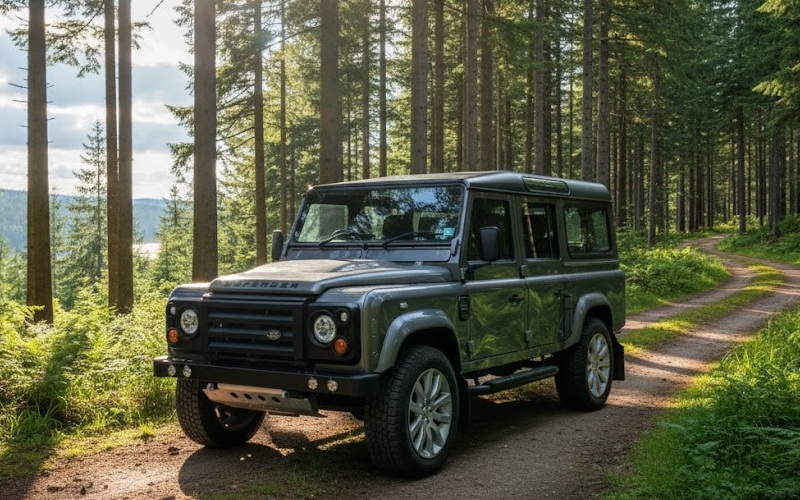
First Generation (1983-1990): The Foundation of Excellence
The initial Land Rover One Ten (introduced in 1983) and Ninety (introduced in 1984) models established the fundamental drivetrain architecture that would define the Defender for decades to come. Though not yet bearing the Defender name, these vehicles represented a significant advancement over the preceding Series III Land Rovers.
Revolutionary Suspension and Four-Wheel Drive
This generation introduced a major drivetrain innovation by replacing the leaf springs of previous Land Rover models with coil springs. This change dramatically improved on-road comfort and off-road articulation, allowing the wheels to maintain better contact with uneven terrain. Engineers derived the coil spring suspension directly from the Range Rover, which had already proven its effectiveness in both luxury and off-road driving.
Equally important was the implementation of permanent four-wheel drive with a two-speed transfer case featuring a lockable centre differential. Previous Land Rover models had used part-time four-wheel drive systems that required the driver to manually engage four-wheel drive when needed. The new system offered several advantages:
Constant power to all four wheels for improved traction in all conditions
The ability to lock the centre differential for extreme off-road situations
Improved on-road handling characteristics, especially in adverse weather
Powertrain Options
The first-generation models initially offered three engine options:
A 2.25-litre petrol inline-four producing approximately 75 horsepower (carried over from the Series III)
A 2.5-litre diesel inline-four with approximately 68 horsepower
A 3.5-litre V8 petrol engine borrowed from the Range Rover, producing approximately 135 horsepower
These engines were paired with several transmission options:
The LT95 four-speed manual transmission with integrated transfer case (primarily with V8 engines)
The LT77 five-speed manual transmission with separate LT230 transfer case
The LT85 five-speed manual for certain diesel variants
The transfer case offered both high and low range ratios. Low range provided a 3.32:1 reduction for extreme off-road conditions, allowing precise control at very low speeds when traversing difficult terrain.
Axles and Differentials
The Ninety and One Ten featured different axle setups based on their intended load capacity. The rear axle of the One Ten employed the heavier-duty Salisbury design—essentially a Land Rover-specific version of the Dana 60. This robust axle featured a hypoid differential with 24-spline axle shafts measuring approximately 1.24 inches in diameter, significantly stronger than previous Land Rover axles. The Salisbury's offset differential housing provided improved ground clearance, while its robust construction could withstand the substantial torque loads from the larger engines.
For the Ninety models, Land Rover initially used the lighter Rover differential design in both front and rear positions, though V8 models received an upgraded 4-pinion version at the rear for additional strength. This Rover axle utilized similar 24-spline shafts but with a more compact differential housing.
Both axle designs featured:
Full-floating design in the rear, where the axle shafts only transmit rotational force without supporting vehicle weight
Semi-floating design in the front, with the inner CV joints allowing for steering movement
Drum brakes standard across most models, with disc brakes appearing on higher-specification variants
A notable innovation in these axles was the front swivel ball arrangement that allowed for both steering and drive to be transmitted to the front wheels. This required regular maintenance but provided excellent articulation and durability in off-road conditions.
Second Generation (1990-2016): Evolutionary Refinements
When the Defender name was officially introduced in 1990, it marked the beginning of a long period of incremental improvements to the proven platform established by the Ninety and One Ten models.
Powertrain Development
Throughout the 1990s and 2000s, Land Rover progressively modernized the Defender engine lineup to meet emissions regulations and customer expectations for performance and efficiency. Key powertrain developments included:
Diesel Evolution
The 2.5-litre diesel engines underwent significant development:
The 200Tdi (1990-1994): Introduced with 107 horsepower and 188 lb-ft of torque, this direct-injection turbocharged diesel represented a major improvement in power and efficiency over previous naturally-aspirated diesels.
The 300Tdi (1994-1998): This refined 111-horsepower engine offered improved noise suppression, smoother operation, and enhanced reliability with 195 lb-ft of torque.
The Td5 (1998-2007): This 2.5-litre five-cylinder electronically-managed diesel introduced modern engine management systems to the Defender, producing 122 horsepower and 221 lb-ft of torque. It represented a significant advancement in both power delivery and emissions control.
The 2.4-litre Ford Transit diesel (2007-2012): As part of Ford's ownership of Land Rover, this 122-horsepower engine brought further emissions improvements and 265 lb-ft of torque.
The 2.2-litre Ford Duratorq (2012-2016): The final diesel offering in the traditional Defender delivered 122 horsepower with 265 lb-ft of torque while meeting increasingly stringent emissions standards.
Petrol Options
The V8 petrol engine options continued to be available in select markets:
The carbureted 3.5-litre V8 gave way to fuel-injected versions producing approximately 135-165 horsepower depending on specification.
Limited numbers of Defenders were produced with the 4.0-litre Rover V8, offering improved power and torque.
Transmission Refinements
The drivetrain components also evolved throughout this generation:
The R380 five-speed manual transmission replaced the earlier LT77, offering improved shift quality and durability.
The LT230 transfer case remained largely unchanged but received internal strengthening and improved sealing to enhance reliability and reduce oil leaks.
Limited numbers of automatic transmissions were offered in certain markets and special editions, typically paired with V8 engines.
Differential and Axle Improvements
The robust axle designs from the first generation continued with several notable improvements:
Front disc brakes became standard equipment across the range, improving braking performance and consistency
Improved CV joints and axle shafts enhanced durability while maintaining the fundamental design.
Later in production, the Rover axles were updated with components from the Range Rover P38, providing increased strength without changing the core architecture.
Electronic traction control was added in later models, complementing the mechanical four-wheel drive system.
Throughout this period, the traditional Defender maintained its permanent four-wheel drive system with the locking center differential—a feature that continued to distinguish it from competitors that often used part-time systems or more road-oriented all-wheel drive setups.
Third Generation (2020-Present): Revolutionary Transformation
After a four-year hiatus following the end of production of the traditional Defender in 2016, Land Rover unveiled an entirely new generation in 2020. This represented the most dramatic reimagining of the Defender concept in the vehicle's history.
Complete Drivetrain Reinvention
The new Defender abandoned nearly all mechanical connections to previous generations, introducing a thoroughly modern drivetrain architecture:
Advanced Monocoque Construction*
Unlike its predecessors, which used a body-on-frame design, the new Defender employs an aluminum unibody structure. This fundamental change dramatically affected the drivetrain integration:
Improved torsional rigidity enhances handling both on and off-road
Weight reduction despite increased dimensions and equipment levels
Optimized mounting points for drivetrain components reduce noise and vibration
Powertrain Revolution
The third-generation Defender offers a diverse range of engine options, all significantly more powerful and efficient than any found in previous models:
A 2.0-litre four-cylinder turbocharged petrol engine producing approximately 300 horsepower
A 3.0-litre inline-six mild hybrid (MHEV) petrol engine delivering 395 horsepower and 406 lb-ft of torque
A 3.0-litre inline-six diesel producing up to 300 horsepower with 479 lb-ft of torque
A 5.0-litre V8 supercharged petrol engine delivering 518 horsepower for high-performance variants
A plug-in hybrid (PHEV) variant combining electric motors with a 2.0-litre petrol engine for 398 horsepower, with the ability to operate in electric-only mode
All engines are paired exclusively with an eight-speed ZF automatic transmission, marking the first time a manual transmission is not offered in a Defender.
Advanced Four-Wheel Drive System
The traditional mechanical four-wheel drive system has been replaced with a sophisticated, intelligent all-wheel-drive architecture:
A two-speed transfer case remains for genuine low-range capability, but is now electronically controlled
Center differential with automatic torque biasing replaces the manual locking mechanism
Available active rear locking differential enhances traction in extreme conditions
Terrain Response 2 system automatically configures vehicle settings for different surfaces
Optional air suspension provides adjustable ride height for both improved clearance off-road and better aerodynamics on-road
The new generation marks a transition from mechanical robustness to electronic sophistication—delivering greater capability through advanced technology rather than traditional mechanical solutions.
Evolution of Legendary Capability
From its humble origins with robust but relatively simple mechanicals in the first generation, through the evolutionary improvements of the second generation, to the revolutionary reimagining in the current model, the Land Rover Defender drivetrain represents an ongoing pursuit of off-road excellence. Each generation has reflected the technological capabilities and market demands of its era while maintaining the vehicle's core purpose.
While purists may debate whether the sophisticated electronic systems of the latest model truly capture the spirit of the original, there's no question that today's Defender offers capabilities its predecessors could only dream of. What remains consistent across all generations is the Land Rover commitment to creating vehicles that can confidently venture far beyond where conventional roads end.
The Defender drivetrain story mirrors the broader evolution of four-wheel drive technology—from purely mechanical systems focused on rugged durability to sophisticated electronically managed systems that provide both capability and comfort. As automotive technology continues to advance toward electrification, the Defender drivetrain will undoubtedly continue to evolve while maintaining its fundamental mission of exceptional off-road performance.


